
POSSIBLE 2026: What Happened in Miami, and Why It Matters Even If You Weren't There
POSSIBLE 2026 drew over 7,200 marketing leaders to Miami Beach, establishing a pragmatic, builder-focused alternative to Cannes Lions. Across algorithmic hosted meetings, high-stakes keynotes by Alexis Ohanian and Terry Kawaja, and frank hallway conversations, one takeaway dominated: AI urgency is peaking, but organizations cannot bridge the gap to execution without rebuilding foundational data trust.
A conference held along the oceanfront at the Fontainebleau Miami Beach presents an immediate test of professional discipline. When more than 7,200 brand marketers, media buyers, agency leaders, adtech founders, and investors convened in late April for POSSIBLE 2026, the contrast between South Beach resort aesthetics and enterprise software realities was unmistakable.
Yet beyond the palm trees, the atmosphere was devoid of festival complacency. Where legacy gatherings often function as victory laps for completed campaigns, POSSIBLE has developed the pragmatic energy of an operational summit. Practitioners did not travel to Miami to admire thirty-second commercials. They arrived to debate bidstream latency, cross-channel attribution decay, retail media networks, and the widening chasm between executive AI mandates and daily data engineering realities.
For anyone who monitored the event from afar and wondered whether POSSIBLE has earned a permanent place on the enterprise calendar, the short answer is yes. But understanding why requires dismantling the lazy comparisons that have surrounded the event since its inception.
 Welcome to POSSIBLE 2026 at the Fontainebleau Miami Beach: blending oceanfront venue atmosphere with high-intensity marketing and adtech dealmaking.
Settling the Comparison: Why POSSIBLE is Not the New Cannes Lions
In the months leading up to the conference, industry trade publications indulged in a familiar parlor game: asking whether POSSIBLE was positioning itself to dethrone Cannes Lions as the premier global advertising event.
The comparison represents a category error.
Cannes Lions, founded in 1954, is organized around creative storytelling and agency craft. Drawing upwards of 20,000 attendees to the Cote d’Azur every June, its gravity is historic: the Palais des Festivals, awards ceremonies, rose lunches along the Croisette, and yachts moored in the Mediterranean. Cannes is where holding companies gather to signal prestige, celebrate triumphs, and conduct executive diplomacy. It is marketing’s royal court.
POSSIBLE operates like a scaled, capitalized market exchange. The Fontainebleau is an iconic luxury venue, but the conversations within its corridors are anchored in mechanics rather than monuments. Programming leans decisively toward programmatic plumbing, privacy-preserving clean rooms, media mix modeling, and AI agent architectures.
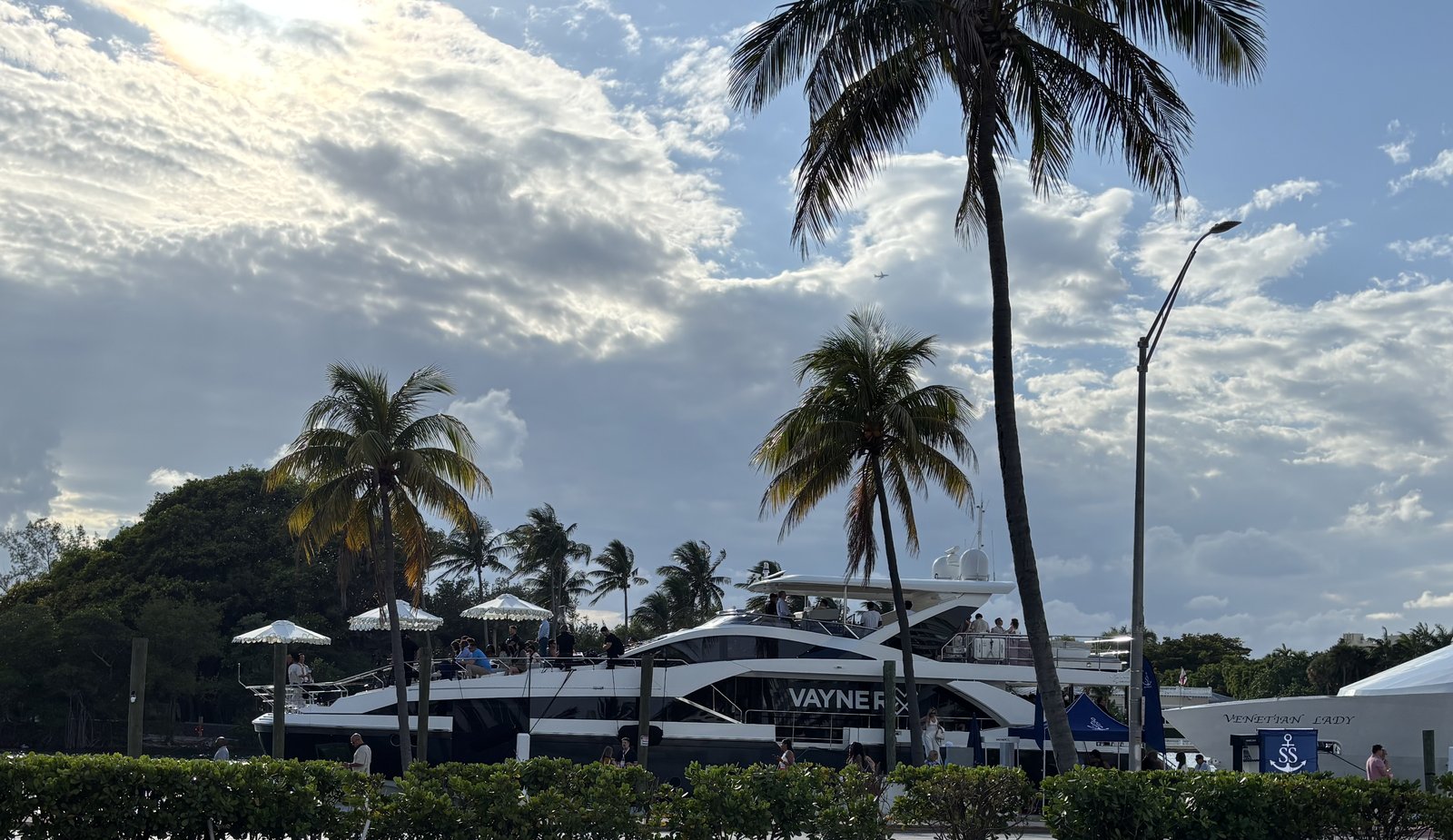 Yachts on the Miami waterways: the familiar Cannes-style luxury branding makes an appearance on Collins Avenue, but the hustle on the ground is distinctly North American operational execution.
Miami offered its own nods to Croisette theater. A branded VaynerMedia mega-yacht was moored across Collins Avenue, signaling that agency holding groups understand the commercial stakes of the week. But the cultural center of gravity remained on dry land, centered around operational execution rather than creative galas.
There is also a macroeconomic variable at play. Marketing executives face budget scrutiny, travel restrictions, and skepticism toward multi-million-dollar European festival expenditures. Justifying a transatlantic journey to the South of France has become politically fraught.
Yet even if American attendance at Cannes dips, POSSIBLE does not simply step in as a direct replacement. The two events serve divergent jobs-to-be-done. Cannes exists to celebrate what has been won; POSSIBLE exists to map what is currently being built. They occupy separate quadrants of the industry calendar, and neither can duplicate the core function of the other.
The Operational Engine: Algorithmic Matchmaking in the Sand
When enterprise vendors and media agencies evaluate POSSIBLE, their budgets are not driven by keynotes or pool parties. The primary commercial engine is the hosted meetings program.
Traditional conferences rely on booth foot traffic, hallway encounters, and speculative LinkedIn outreach. POSSIBLE strips away this randomness through a structured algorithmic matchmaking system known as POSSIBLE Connect.
Hosted inside a beachfront pavilion against the Atlantic tide line, the setup resembles a high-density exchange for enterprise software. Attendees are matched through algorithmic intake based on evaluation briefs, budget authority, and technology requirements for strict 15-to-20-minute windows at assigned tables across the floor.
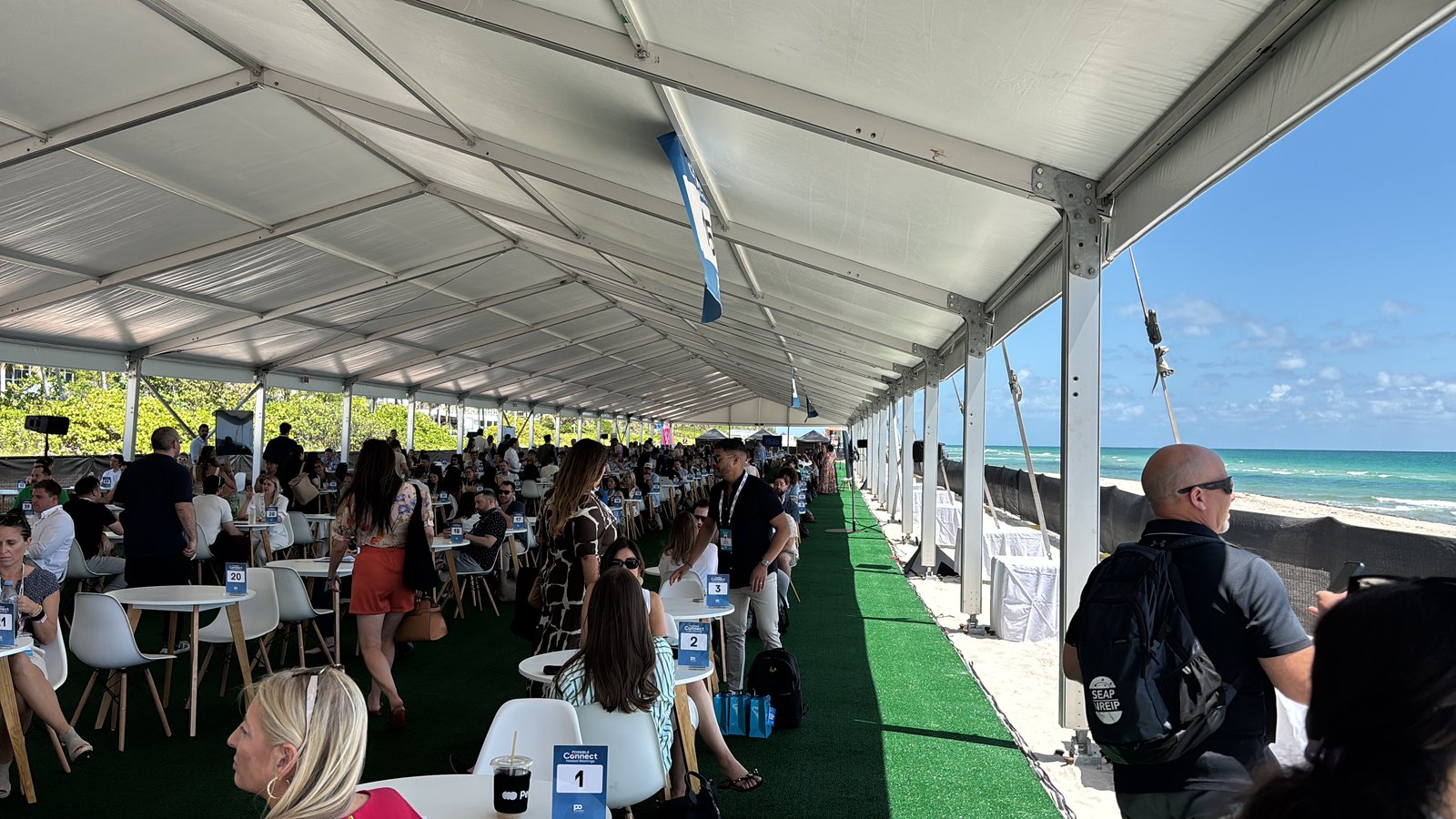 The engine room of POSSIBLE: the beachfront Connect tent where algorithmic matchmaking drove hundreds of structured 15-minute brand and partner meetings.
Sitting down at Table 51 for a rapid-fire consultation with a stranger can feel clinical, especially against the backdrop of ocean waves. But the operational efficiency is difficult to dispute.
Because both participants opt into the agenda and understand the time constraints, customary pleasantries are eliminated. Conversations bypass generalities within ninety seconds: What does your first-party identity graph look like? How are you handling warehouse-native data activation? Where are your API connectors breaking under high-volume streaming data?
For a B2B martech or adtech vendor, this format compresses three to four months of fragmented outbound sales development and enterprise qualification into forty-eight hours. It transforms a trade show from a speculative brand-marketing expense into a measurable, pipeline-generating asset.
Signals from the Stage: Attention Asymmetries in Modern Media
While the meeting pavilions hummed with transactional mechanics, the stage programming provided valuable macro context. Two sessions in particular delivered high-signal analytical frameworks that cut through conventional marketing rhetoric.
The 3C Ventures Sports Innovation Breakfast: The 10:1 Asymmetry
On Tuesday morning at Prime 54 inside the Fontainebleau, Michael Kassan (Founder and CEO of 3C Ventures) hosted a private breakfast discussion featuring Alexis Ohanian, co-founder of Reddit and founding partner of Seven Seven Six (776). Ohanian, a prominent institutional investor in professional women’s sports and digital media properties, laid out a compelling thesis on attention arbitrage.
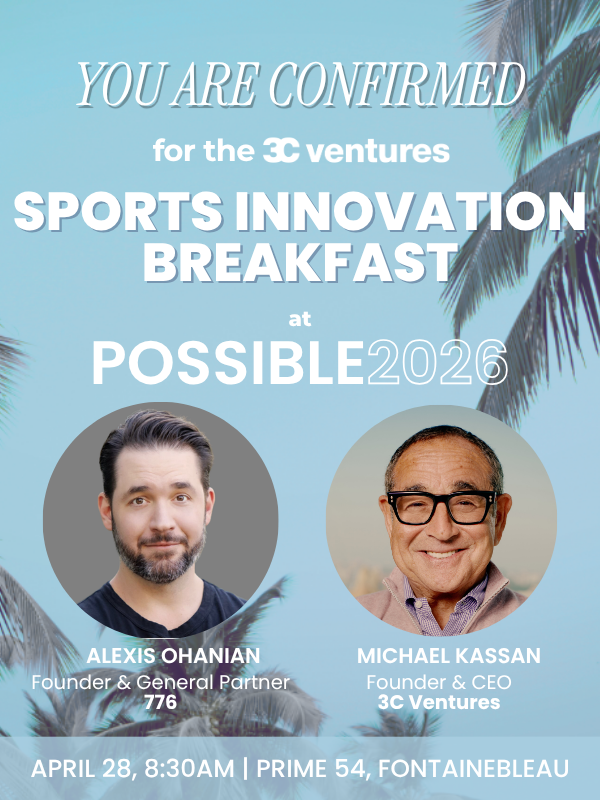 Alexis Ohanian and Michael Kassan headlined the 3C Ventures Sports Innovation Breakfast at Prime 54, spotlighting the massive advertiser undervaluation of women’s and niche sports.
Ohanian’s core argument centered on a structural disconnect: when analyzing digital engagement, follower velocity, and audience sentiment across elite athletes in the exact same discipline, female athletes frequently outperform male counterparts by a margin of nearly 10:1. Yet legacy brand sponsorship spend and broadcast ad pricing remain overwhelmingly indexed to legacy male leagues.
In media economics, persistent disparities between consumer attention and advertiser spend represent classic arbitrage windows. Agile consumer brands that bypass legacy upfront commitments and allocate capital directly into high-affinity female sports ecosystems capture outsized reach at a fraction of traditional CPMs.
Ohanian pushed the thesis into the four-year black hole of Olympic and niche athletic disciplines. Under twentieth-century broadcast models, elite athletes in gymnastics, track and field, or swimming enjoyed global attention for two weeks every Olympiad, only to vanish for the subsequent forty-seven months.
Broadcast networks required massive, lowest-common-denominator aggregation to justify overhead, meaning niche micro-communities could not be served profitably outside the Olympic window. With algorithmic feeds, streaming platforms, and generative content workflows, that distribution bottleneck has evaporated. Dedicated micro-audiences follow specialized athletes year-round, creating fertile ground for vertical media networks built on modern digital infrastructure.
Terry Kawaja on the Vision Stage: Tectonic Disruption and the Intermediary Squeeze
Later that afternoon on the panoramic Vision Stage, Terry Kawaja, founder and CEO of LUMA Partners, delivered a characteristically blistering assessment of the adtech landscape entitled “AI & Advertising: Prepare for Tectonic Disruption.”
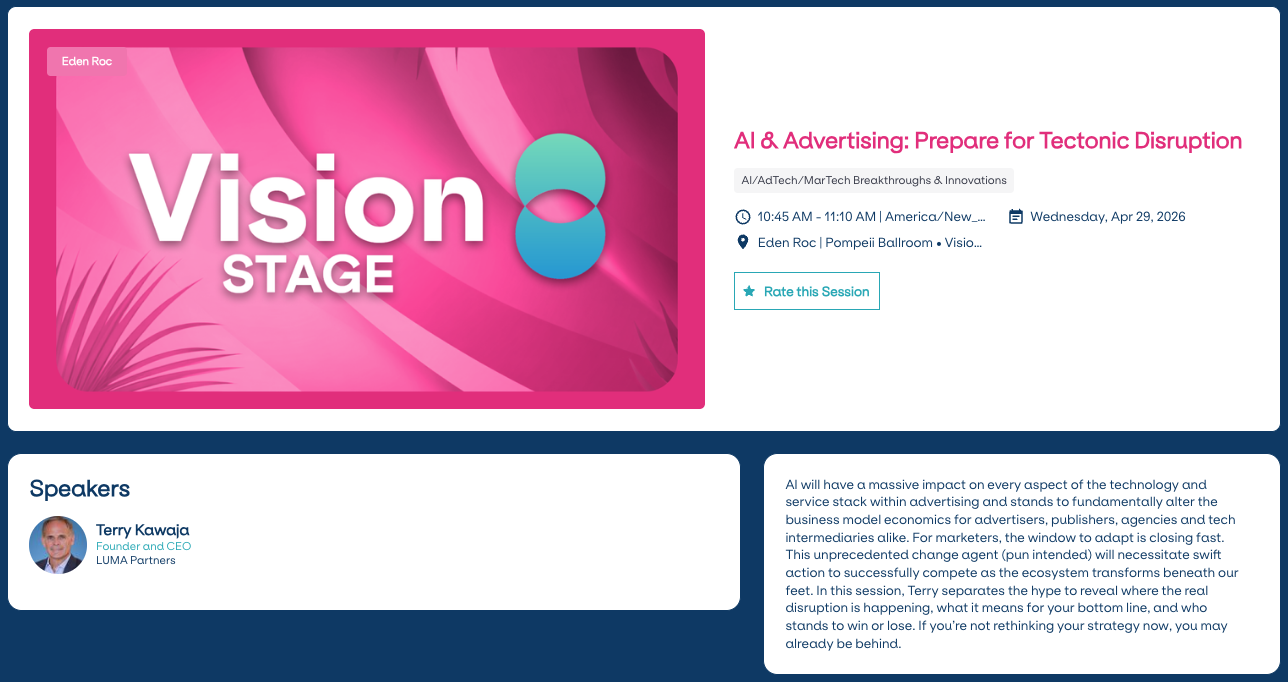 Terry Kawaja’s Vision Stage program listing: LUMA Partners’ founder laid out why AI-driven consolidation will reshape adtech intermediaries and ignite a creative renaissance.
Kawaja dismissed the notion that adtech’s challenges are part of an ordinary cyclical downturn. Instead, he presented a thesis of non-reversible structural realignment driven by autonomous systems and generative AI.
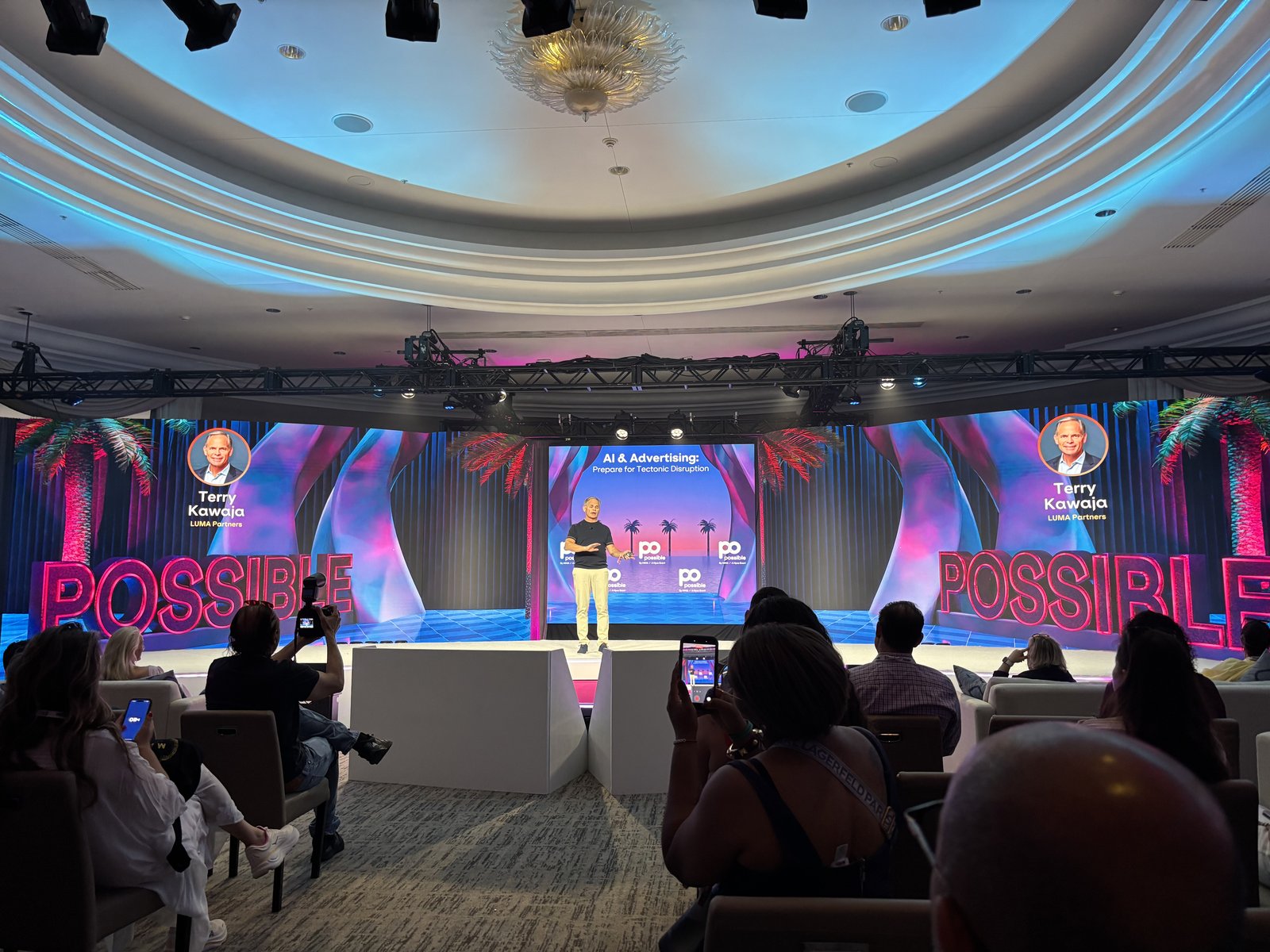 Terry Kawaja on the Vision Stage: “Real AI tech will manifest in greater operating leverage; faster growth, higher margins, and greater revenue per FTE.”
Kawaja segmented the impending fallout into four structural categories:
- The Intermediary Squeeze: Adtech intermediaries operating as passive tax collectors (arbitraging inventory or clipping basis points off bidstreams without proprietary data or verified attribution) face extinction. As algorithmic walled gardens and direct programmatic rails consolidate, intermediaries lacking defensible intellectual property will be disintermediated.
- The Publisher Dilemma: Digital publishers confront an acute threat from AI answer engines (including Google AI Overviews, Perplexity, and conversational search agents) synthesizing answers directly in the interface rather than routing organic referral clicks. The legacy open-web monetisation model is breaking down.
- The Creative Renaissance and the Data Bottleneck: While the marginal cost of producing multi-variant creative has plummeted toward zero, infinite variations do not guarantee effectiveness. They merely shift the bottleneck to deterministic audience routing. Without pristine first-party customer signals, automated creative engines simply generate personalized noise at scale.
- Operating Leverage: For enterprise technology providers, genuine AI adoption will be measured by economic leverage: faster top-line growth, expanding gross margins, and surging revenue per full-time employee (FTE).
Ground Truth from the Hallways: The Enterprise Data Trust Deficit
While stage presentations projected bold visions of automated marketing futures, conversations across conference lounges and coffee bars revealed an entirely different ground truth: acute implementation anxiety.
Whenever marketing directors, agency leaders, or enterprise analytics heads were asked how their teams were deploying artificial intelligence in day-to-day operations, the candid answers clustered into two confessions:
- “Yes, our executives talk about it constantly, but we are not using it nearly as much as leadership believes.”
- “We are essentially just getting started. We came to Miami hoping to see working architectures from peers.”
Despite two years of public hype, virtually no practitioner claimed a mature, autonomous operational workflow. The gap between boardroom urgency and frontline execution remains vast.
Frontline teams do not point to deficiencies in frontier AI models. Models like Claude 3.5 Sonnet, GPT-4o, and Gemini 1.5 Pro possess ample reasoning capability to optimize bids and segment audiences. The real bottleneck is a systemic crisis of data trust.
A modern enterprise marketing stack is an archipelago of disconnected silos: ad platform performance reports across Meta, Google, TikTok, Amazon, and LinkedIn; customer interactions inside CRM platforms; web analytics in GA4; conversion metrics in transactional databases; and fragmented data lakes in Snowflake or BigQuery.
These platforms speak incompatible schemas, report on conflicting attribution windows, and continuously drift out of sync due to API deprecations and silent pipeline breakages. Frontline practitioners spend hours manually reconciling discrepancies across spreadsheets rather than executing strategic analysis.
Deploying an autonomous AI agent on top of an unverified data foundation is organizational suicide. If a marketing leader cannot trust their underlying warehouse pipeline to report customer acquisition cost accurately across paid channels, they will never grant an algorithmic agent write-back authority to reallocate ad budgets.
The Financial Services Reality Check: When Claude Replaces the BI Dashboard
The practical consequence of this trust deficit was illustrated during a revealing discussion with analytics leadership at a major financial services enterprise.
The company’s media analytics team admitted to an unexpected operational workaround: when preparing performance briefs and diagnosing campaign variance, frontline analysts actively preferred querying raw data extracts through Anthropic’s Claude over consulting their own internal, enterprise-wide Business Intelligence dashboards.
The rationale was not that Claude possessed domain foresight. It was that the internal BI dashboards had suffered from years of brittle batch ETL failures and opaque synchronization schedules. Analysts had been burned too often presenting numbers from corporate dashboards quietly invalidated by upstream schema drifts.
Claude, by contrast, felt objective and transparent: analysts could feed a verified CSV extract into the context window, prompt for specific multi-touch attribution logic, and inspect the reasoning step by step. Probabilistic AI had become more trusted than deterministic enterprise reporting simply because legacy data pipelines had lost their credibility.
This anecdote captures the central dilemma of modern marketing technology. You cannot leapfrog data hygiene. Until organizations build resilient, automated data integration pipelines that ingest, normalize, and validate multi-channel signals in real time, enterprise AI in marketing will remain confined to superficial copy generation and slide summaries.
Strategic Decision Matrix: Should POSSIBLE Be on Your 2027 Calendar?
As marketing budgets face intensifying scrutiny heading into next year, marketing executives must make deliberate choices about where to commit conference capital and executive hours.
| Attendee Persona | Verdict | Strategic Rationale |
|---|---|---|
| Performance Marketers & Growth Leaders | Must Attend | Direct exposure to clean room architectures, signal loss workarounds, and algorithmic media buying mechanics. |
| Marketing Operations & Data Engineers | Must Attend | High-density peer validation for composable data stacks, API pipeline orchestration, and semantic warehouse layers. |
| B2B Martech & Adtech Founders | Must Attend | The hosted 1-on-1 meeting format delivers tangible, qualified enterprise pipeline faster than traditional trade show exhibits. |
| North American Media Buyers | High Value | High-density peer networking and media dealmaking without the transatlantic travel friction and excessive cost of Cannes. |
| Creative Directors & Brand Storytellers | Skip / Prioritize Cannes | The programming and crowd are overwhelmingly indexed to data plumbing, programmatic media, and AI infrastructure rather than artistic craft. |
| Generalist Marketers / Unprepared Teams | Skip | POSSIBLE penalizes casual browsing. The event strictly rewards attendees who arrive with pre-booked meetings and concrete technical evaluation criteria. |
For our own team, the investment delivered immediate operational dividends. Beyond dozens of structured partner consultations across the floor, the event provided dedicated space for solution engineering and product leaders to debrief customer pain points in real time and calibrate technical priorities against ground truth.
 Beyond the conference floor: debriefing customer conversations and celebrating team milestones over dinner in Miami Beach.
The Structural Takeaway: The Bifurcation of the Industry
The true significance of POSSIBLE 2026 is that it marks the formal structural bifurcation of the advertising and marketing conference circuit.
For decades, the industry assumed a single gathering could encompass every facet of the discipline; that one festival could honor cinematic television commercials, debate algorithmic auction mechanics, and negotiate enterprise software contracts.
That unified paradigm has broken down. The operational demands of modern marketing have become too technical to be subsumed into an annual festival of creative craft.
The industry is diverging into two distinct institutional spheres. On one side sits Cannes Lions: a global cultural institution celebrating the power of creative brand narrative, executive prestige, and industry community. On the other side sits POSSIBLE: an intensive, North American operational clearinghouse built for the engineers, media operators, and data leaders who build the underlying machinery of modern commerce.
For data teams and marketing leaders, the mandate is clear. The primary challenge facing modern marketing is no longer model capability or creative throughput. It is the urgent, unglamorous work of constructing trustworthy data infrastructure. The organizations that succeed in the coming agentic era will not be those with the flashiest AI slogans; they will be the teams that solved their data pipelines first.