
Same Themes, Different Order: What Cannes Lions 2025 Revealed About AI Workflows, CTV Arbitrage, and Commerce Media
Beyond the Mediterranean spectacles and yacht hospitality of Cannes Lions 2025, three operational shifts defined the festival: Meta's aggressive timeline for autonomous advertising pipelines, a stubborn programmatic arbitrage between streaming viewership and linear budgets, and the escape of retail media into full-funnel commerce networks.
It is notoriously easy to get distracted by the sensory excess of the Cannes Lions International Festival of Creativity. The Boulevard de la Croisette during the third week of June offers an almost comical concentration of corporate largesse: multi-tiered beach cabanas, private yacht charters anchored off the harbor, overflowing flutes of chilled rosé, and private harbor dinners. For decades, the festival has traded on this theatrical sensationalism, positioning itself as the global summit where Madison Avenue’s creative elite gathers to celebrate brand craft.
 Branded beach takeovers and giant installations along the Croisette: the lavish hospitality of Cannes Lions frames an increasingly cutthroat structural realignment in digital advertising.
Yet anyone who has navigated the Croisette through multiple market cycles recognizes that the champagne and beachfront installations are merely decorative camouflage. The true value of Cannes Lions has always been its function as an unvarnished index of commercial leverage. Beneath the veneer of artistic awards, the festival operates as a high-stakes trading floor where media platforms, enterprise holding companies, independent AdTech vendors, and major brand advertisers negotiate the structural rules of the digital economy.
In 2024, those negotiations were defined by speculative curiosity and fragmented experiments. Marketers toyed with generative copy tools, debated third-party cookie contingencies, and wondered aloud whether retail media networks were multiplying beyond sustainable capacity. By the summer of 2025, the tone had shifted decisively. The headline themes remained familiar, but their strategic hierarchy and operational maturity had completely reorganized: “Same themes this year, different order.”
 Evan Kaeding and Lauri Putkinen at the Google Beach: stepping away from the Croisette heat to debate programmatic measurement, identity resolution, and algorithmic workflows.
Three dominant vectors shaped every serious executive conversation along the French Riviera: the industrialization of artificial intelligence into end-to-end autonomous campaign systems, the widening economic disconnect in Connected TV (CTV) between consumer attention and media spend, and the programmatic breakout of Retail Media into universal Commerce Media. Together, these vectors signal an industry transitioning rapidly from discretionary experimentation to ruthless operational execution.
Artificial Intelligence: The Shift to Autonomous Production Pipelines
If artificial intelligence was treated as a speculative novelty at Cannes in prior years, 2025 marked its formal induction as the foundational operating layer of modern media. The debate has moved far beyond generative copy prompts or synthetic imagery parlors. The new competitive frontier is the complete algorithmic orchestration of the advertising lifecycle.
The defining proclamation of the week arrived from Meta. In an announcement that reverberated across agency breakfast briefings, Meta stated its intention to deliver a fully autonomous, AI-powered advertising pipeline by the end of 2026. The vision is sweeping: an integrated system capable of generating creative variants dynamically, structuring multi-tiered campaign architectures, managing real-time bidding, and synthesizing closed-loop attribution reporting without requiring manual operator intervention.
 Creative production turns algorithmic: the TikTok pavilion in Cannes, where discussions focused on automated video synthesis and short-form ad generation.
This roadmap represents an existential philosophical pivot for performance marketing. For nearly two decades, digital campaign execution has relied on an army of agency media buyers, campaign managers, and optimization specialists manually tweaking audience parameters, creative rotations, and budget pacing inside Ads Manager. Meta’s trajectory effectively depreciates that manual labor, transforming human operators into prompt designers, policy overseers, and high-level financial arbiters.
Across the broader platform landscape, visual and conversational AI were deployed directly into consumer search and creative workflows:
- Google showcased deep integrations of visual generative AI into its core search interface, running live demonstrations of “AI Mode” and generative sandbox tools alongside video generation models at the Google Beach.
- Pinterest expanded its visual discovery algorithms, matching consumer visual context directly against dynamic merchant feeds.
- TikTok introduced automated creative synthesis tools designed to transform static product catalog images into high-conversion vertical video units in real time.
- Reddit unveiled “Reddit Answers,” synthesizing its two decades of unfiltered human conversational history into structured query answers, unlocking a net-new discovery surface for brand placement.
Crucially, brand marketers have shifted their technical curiosity toward prompt discovery. A recurring topic among enterprise media leads was how to ensure brand authority within the retrieval-augmented generation (RAG) outputs of frontier language models, whether through organic information architecture or early paid inclusion formats.
Yet behind this technical enthusiasm ran an undeniable current of professional unease. The persistent contraction in agency employment across major Western markets, combined with aggressive holding company restructurings, formed the unspoken background of many private discussions. The productivity gains promised by autonomous ad pipelines are no longer theoretical; they are visibly reshaping headcounts. For advertisers, the operational mandate is clear: competitive advantage no longer stems from merely licensing an AI tool, but from the speed with which an organization can restructure its data pipelines to feed algorithmic engines.
Connected TV: The Structural Arbitrage Between Attention and Allocation
The macroeconomic narrative surrounding television advertising has reached a fascinating inflection point. Landmark viewing figures confirmed what streaming operators have long asserted: consumer viewing time is now divided precisely 50/50 between Connected TV and legacy Linear TV.
In a perfectly efficient market, capital follows attention. In the advertising industry, however, institutional inertia routinely delays economic equilibrium. Despite streaming commanding half of total television viewing, media budget allocations remain heavily skewed toward legacy linear broadcast. Billions of advertising dollars continue to flow into linear programming, sustained by multi-million-dollar upfront commitments, entrenched agency commission structures, and the perceived safety of legacy gross rating points (GRPs).
This allocation mismatch has created a pronounced structural arbitrage. High-intent, digitally native audiences are spending their evenings on streaming platforms, yet the inventory often commands lower relative pricing or remains underutilized by performance advertisers who assume television is strictly an upper-funnel branding luxury.
That assumption is crumbling as CTV infrastructure undergoes rapid democratization. Historically, programmatic CTV was the exclusive preserve of enterprise brands equipped with massive annual minimum commitments and specialized trading desks operating inside demand-side platforms (DSPs) such as The Trade Desk, Amazon DSP, and StackAdapt.
Over the past twelve months, the market has expanded aggressively into the long tail. Platforms such as Vibe and Roku are opening self-serve, performance-oriented CTV buying consoles tailored specifically for mid-market and SMB advertisers. Smaller direct-to-consumer and B2B brands can now procure targeted, geographic, and demographic streaming inventory with the ease and granularity previously associated with Meta Ads Manager or Google Search.
Simultaneously, the measurement methodology governing CTV has matured. The era of evaluating streaming campaigns purely on completion rates or reach estimates is coming to a close. Data highlighted during festival panels revealed a dramatic ten-fold increase in CTV incrementality testing year-over-year in early 2025, driven by partnerships between self-serve streaming platforms and independent statistical modeling firms like Haus. Advertisers are running disciplined geographic holdout experiments, proving that television advertising can drive measurable, bottom-funnel revenue lift when executed with mathematical rigor.
Any marketing executive still treating CTV as an unaccountable branding line item is operating on an obsolete mental model. The convergence of self-serve programmatic access and rigorous incrementality testing has transformed the living room screen into an actionable performance channel.
From Retail Media to Commerce Media: Escaping the Supermarket Aisle
If Cannes 2023 was the coming-out party for supermarket retail media networks, and 2024 was their consolidation, Cannes 2025 marked their escape velocity. Retail Media has officially graduated into a broader, more ambitious discipline: Commerce Media.
The distinction is far more than semantic branding. Retail media traditionally described closed-loop ad networks operated by grocery chains and general merchandise retailers (such as Amazon, Walmart, and Target), allowing consumer packaged goods (CPG) brands to purchase sponsored product placements near the point of sale.
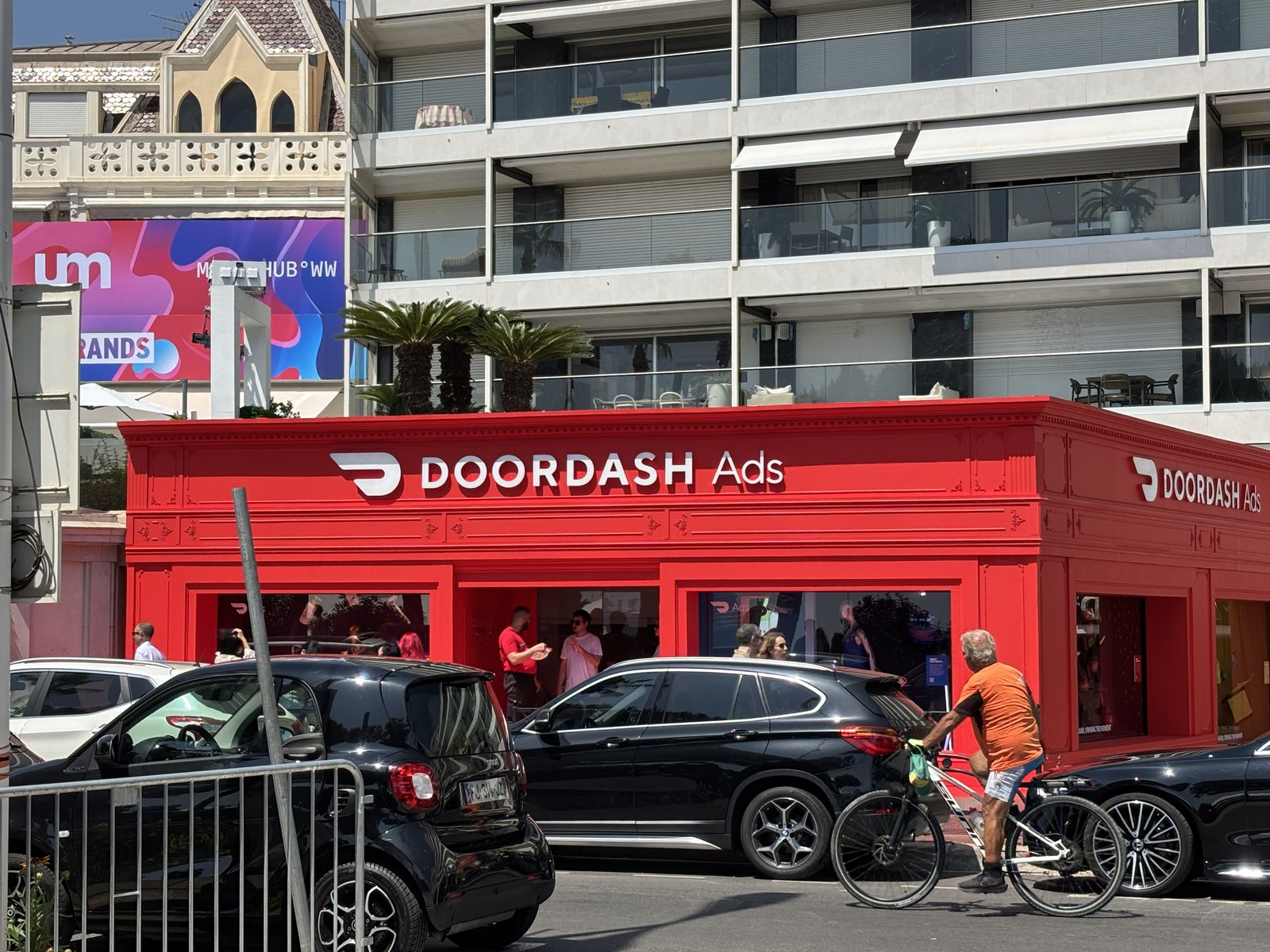 DoorDash staked out prime Croisette real estate with an unmissable building takeover, demonstrating how last-mile delivery platforms are commanding high-intent media budgets.
Along the Croisette this year, the dominant players redefining commerce media were entities with minimal connection to traditional supermarket shelves:
- DoorDash Ads executed an unmissable physical takeover of a prominent building on the Boulevard de la Croisette, signaling that on-demand delivery logistics platforms have built full-funnel advertising networks with immediate transaction attribution.
- United Airlines (Kinective Media) demonstrated how airline booking data, loyalty program tiering, and seatback entertainment screens can be packaged into a premium advertising network reaching high-net-worth business travelers.
- PayPal detailed how deterministic payment transaction histories across millions of merchants can power precision off-site audience modeling without relying on third-party cookies.
- Marriott Bonvoy showcased its hospitality media network, activating traveler intent and hotel dwell-time signals directly at the JW Marriott on the Croisette.
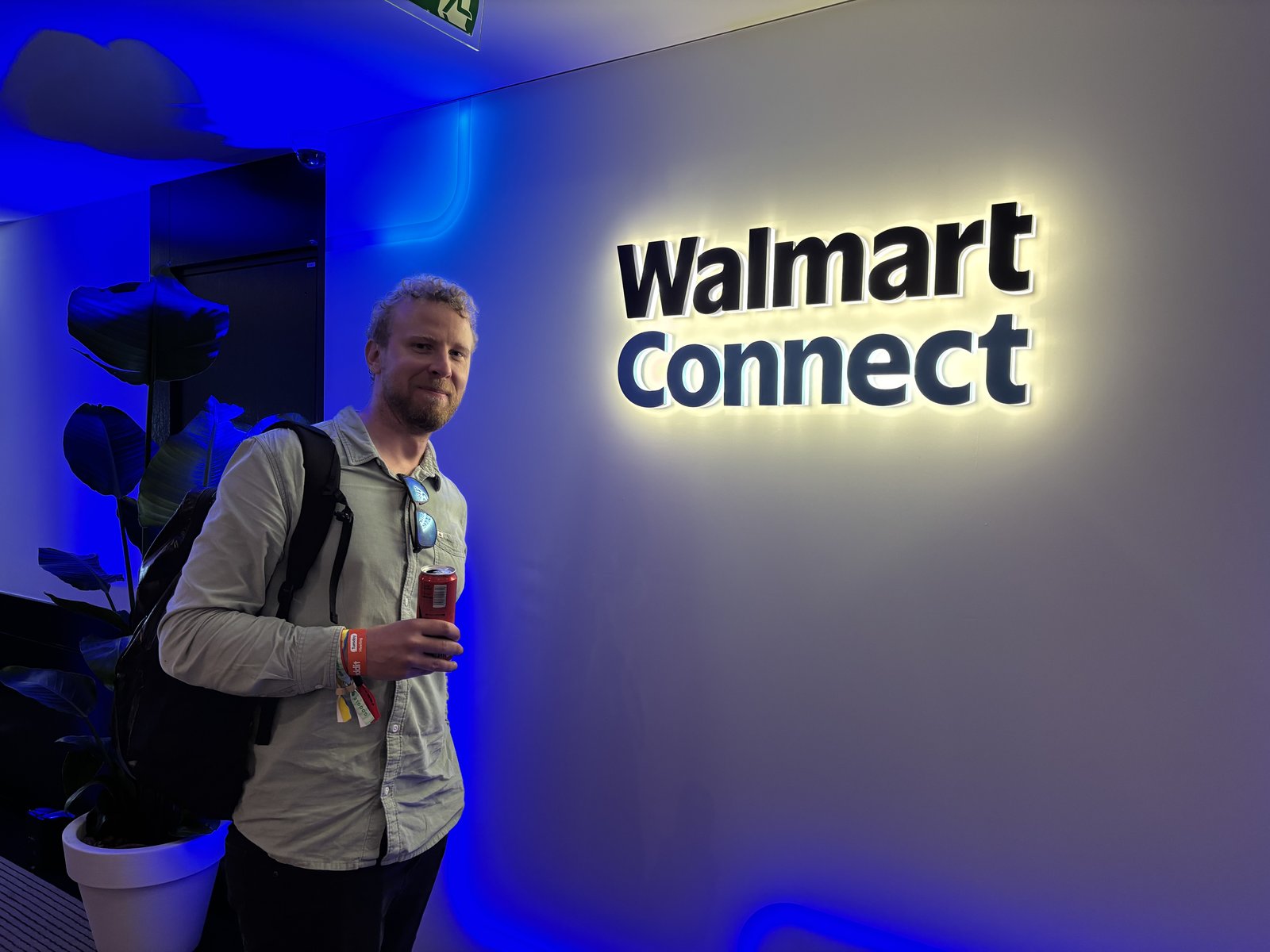 Retail media powerhouses like Walmart Connect anchored discussions on closing the loop between physical retail checkout data and programmatic media execution.
This expansion into non-endemic advertising represents a profound realignment of marketing budgets. A financial institution, an automotive brand, or a luxury watchmaker can now leverage the verified purchase data of a delivery app or an airline loyalty program to target qualified buyers across the open web.
The critical technical milestone enabling this transition is the programmatic unbundling of commerce inventory. For years, retail media networks operated as walled gardens, forcing media planners to log into disparate, proprietary portals to place spend. That operational friction severely limited scalability.
The turning point was crystallized by Uber Ads, which announced during the festival that its high-intent video and display ad placements can now be procured programmatically through external DSPs: The Trade Desk, Google Display & Video 360 (DV360), and Yahoo DSP. By allowing programmatic buyers to bid on high-fidelity mobility and delivery signals within their centralized enterprise workflows, commerce media networks are unlocking institutional budgets that previously refused to endure bespoke manual buying environments.
The Measurement Renaissance and Identity Activation
With third-party browser cookie deprecation finally fading from the panic cycle, the technical focus has pivoted toward operational durability: deterministic identity resolution, first-party data activation, and independent measurement.
The collective sentiment along the Croisette suggested a growing fatigue with platform-graded scorecards. When walled gardens evaluate their own performance, return on ad spend (ROAS) figures inevitably trend upward while overall business growth remains flat. In response, enterprise advertisers are demanding independent third-party measurement architectures that can establish objective, cross-platform incrementality.
 Supermetrics formally announced the acquisition of Relay42 at Cannes, pairing automated data pipelines with real-time deterministic identity resolution and customer data activation.
Simultaneously, the mechanics of audience activation have migrated upstream into the enterprise data stack:
- WPP launched “Open Intelligence”: A proprietary marketing foundational model engineered to ingest identity-based purchase and behavioral signals from participating retail and commerce network partners, creating an integrated data fabric for its global clients.
- Supermetrics acquired Relay42: Supermetrics formally announced the acquisition of Relay42, a Realtime Customer Acquisition Platform with sophisticated deterministic identity resolution and customer journey activation capabilities. The transaction underscores an industry-wide pivot: extracting marketing data from advertising APIs into data warehouses is no longer sufficient; the data must be unified in real time and pushed back into media execution engines to drive dynamic personalization and audience suppression.
- Agencies as Systems Integrators: Confronted with structural margin compression on pure creative and media buying fees, holding companies and independent agencies are aggressively rebranding as technology integrators. Strategic alliances between enterprise agencies and technology providers (such as DEPT. partnering with NVIDIA to construct proprietary AI pipelines) demonstrate how agency longevity depends on building software and data infrastructure rather than merely billing human hours.
Looking Ahead: The Programmatic Imperative
The excess of the Cannes Lions Festival often tempts observers to dismiss it as an echo chamber detached from day-to-day commercial realities. Yet beneath the parties and yacht pavilions, the 2025 festival delivered a clear verdict on the structural trajectory of digital advertising.
The industry is navigating an uncompromising convergence:
- Creative production is becoming algorithmic: As platforms automate multi-variant asset generation, the human role shifts from producing volume to articulating brand distinctiveness and setting strategic boundaries.
- Media buying is becoming autonomous: The manual configuration of campaigns is giving way to closed-loop machine learning models, rewarding organizations whose data architectures provide the cleanest training and conversion signals.
- Commercial data is breaking out of silos: From Connected TV screens in the living room to delivery apps and airline seatbacks, verified first-party transaction data is now accessible across the open programmatic ecosystem.
The winners of the next market cycle will not be the organizations that produce the loudest festival spectacles or launch isolated generative AI experiments. The advantages will belong entirely to the operators who modernize their underlying data plumbing, dismantle proprietary friction, and build systems capable of moving seamlessly between algorithmic creative generation, precision programmatic buying, and mathematically rigorous measurement.