
AI is Disrupting BI: Why Marketing is the Canary in the Coalmine
Data engineering teams can no longer afford to treat marketing as someone else's problem. Because marketing operates on liquid capital and instant feedback loops, it has become the enterprise proving ground for agentic workflows, semantic memory, and write-back architectures that will reach finance and operations within months.
A London Underground strike is an unexpectedly effective filter for conference attendance. When Data Decoded London opened at the newly refurbished Olympia in April, the transit disruption filtered out casual swag-hunters and left behind senior practitioners: Business Intelligence directors, principal data engineers, and analytics leads.
This was decidedly infrastructure territory. Our booth sat adjacent to Pentaho, flanked by Fivetran, Datadog, Oracle, Domo, and ThoughtSpot. Traditionally, mentioning “marketing data” to core infrastructure engineers invites polite detachment; marketing is viewed as a noisy downstream consumer of warehouse tables rather than serious distributed systems.
So when I opened my keynote at the AI, Analytics & Intelligence Theatre with “AI is Disrupting BI: Why Marketing is the Canary in the Coalmine,” I anticipated skepticism. Instead, the room leaned in. Afterward, company founders and private equity operating partners approached the podium with a consistent reaction: they wanted to roll out these exact patterns across their portfolios, recognizing that marketing analytics today is a six-month preview of what is heading for the rest of the enterprise data stack.
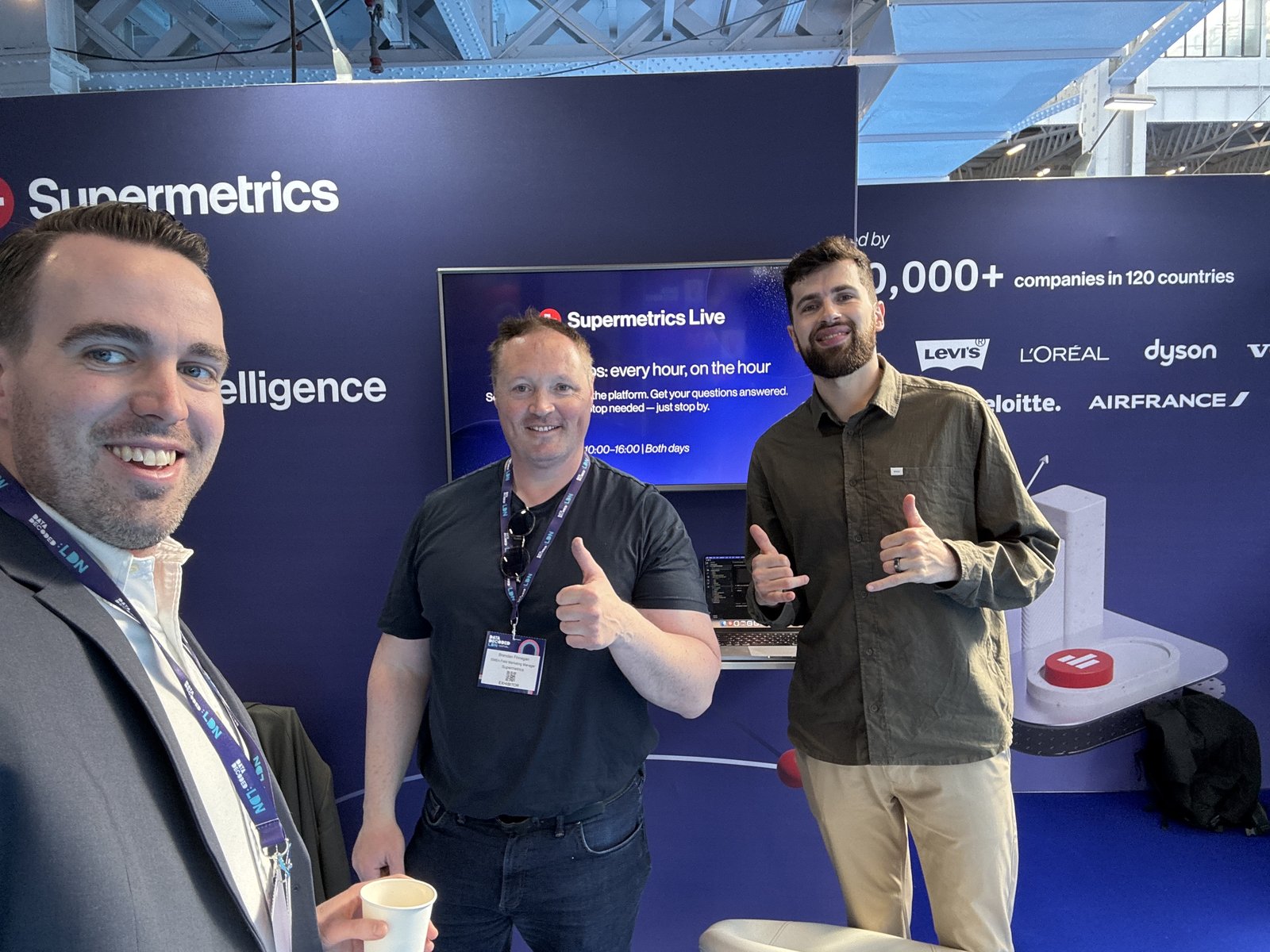 Data Decoded London 2026 at Olympia: a transit strike kept the exhibition floor lean, which meant conversations with senior BI and data engineering leaders ran longer and deeper.
Why Marketing is the Proving Ground for Enterprise AI
To understand why data teams should care about marketing workflows, start with capital structure rather than software tooling.
Three of the ten largest public companies on earth by market cap (Alphabet, Meta, and Amazon) derive substantial double-digit revenue from advertising. Collectively, they represent roughly a third of the $25 trillion in market value across the global top ten. Enterprise AI allocation mirrors this gravity: according to the MIT NANDA benchmark (The GenAI Divide: State of AI in Business 2025), nearly 50% of all enterprise Generative AI project investment flows into marketing and sales functions.
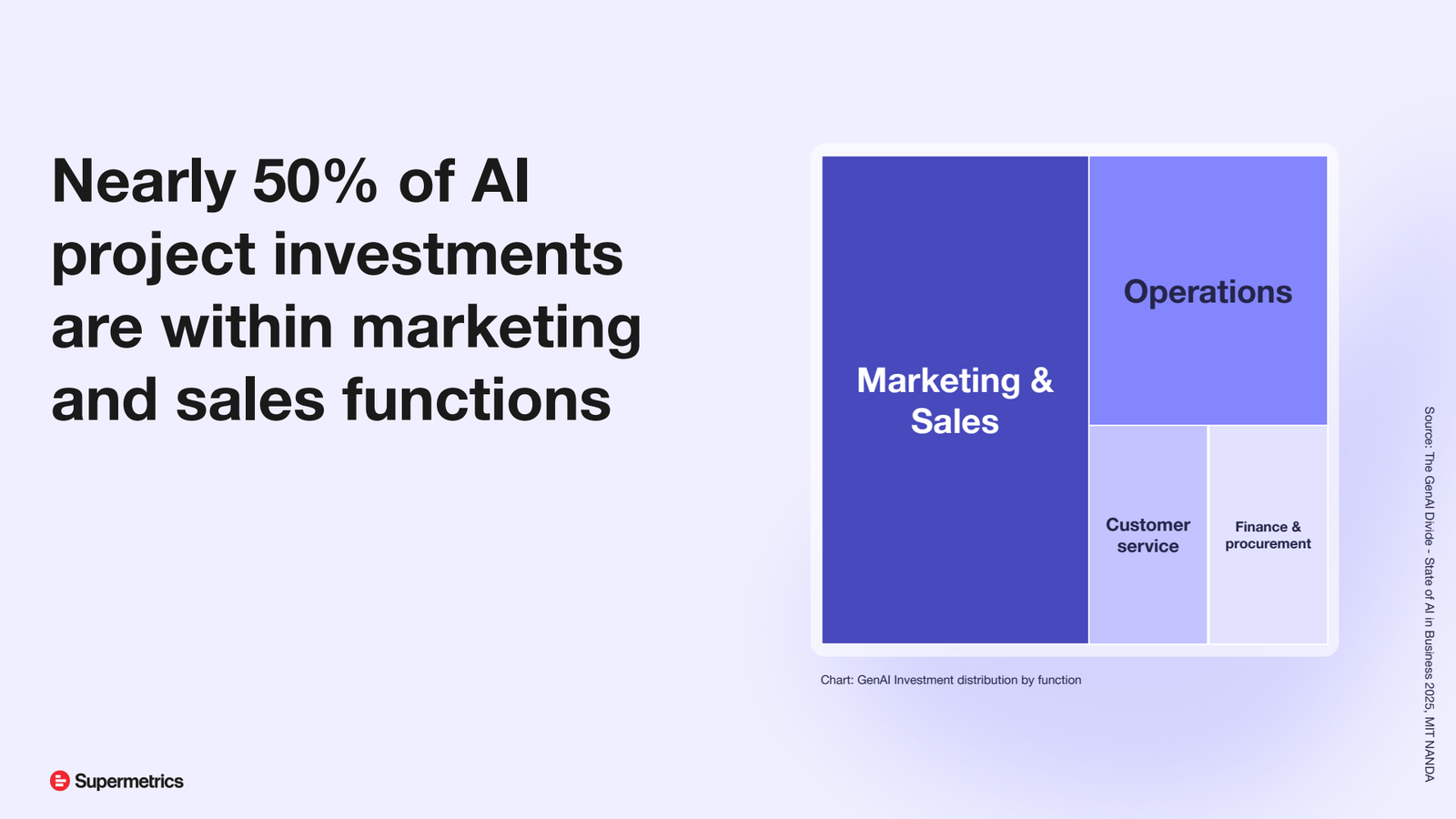 Marketing is where enterprises place their largest initial AI bets: nearly half of all generative AI project investments are concentrated in marketing and sales workflows (Source: MIT NANDA).
Why does half of enterprise AI capital gravitate toward marketing before touching core operations? The answer is the accounting distinction between fluid capital and Property, Plant, and Equipment (PP&E).
Restructuring factories, logistics fleets, or ERP backbones takes years and massive capital commitments locked in fixed assets. Marketing spend, by contrast, is liquid capital. Budgets and channel allocations can be redirected in hours. Combined with instant feedback loops from digital ad auctions, marketing lets enterprises test fast, fail fast, and iterate without rearranging physical infrastructure.
When frontier models make code generation trivial, the bottleneck shifts from writing software to governing context. The architectural challenges emerging in marketing today (agent orchestration, real-time decisioning, semantic memory, and programmatic write-back) will reach finance, supply chain, and operations within six to twelve months.
The Mood in the Room: The Clock is Running, and Nobody Has It Figured Out
The VIP dinner the night before the event made one truth clear: nobody has AI figured out. Not vendors, not enterprise customers, and not the frontier labs. Everyone is watching Anthropic, Google, and OpenAI closely because raw model capability is outrunning organizational adoption by a wide margin.
At the booth, conversations started with curiosity and ended twenty minutes later with data leaders saying some variation of, “I knew this was important, but I had no idea how fast it was moving. I need to talk to my boss next week.” What they planned to pitch was not adopting another AI tool, but changing their organization’s mentality and operating model.
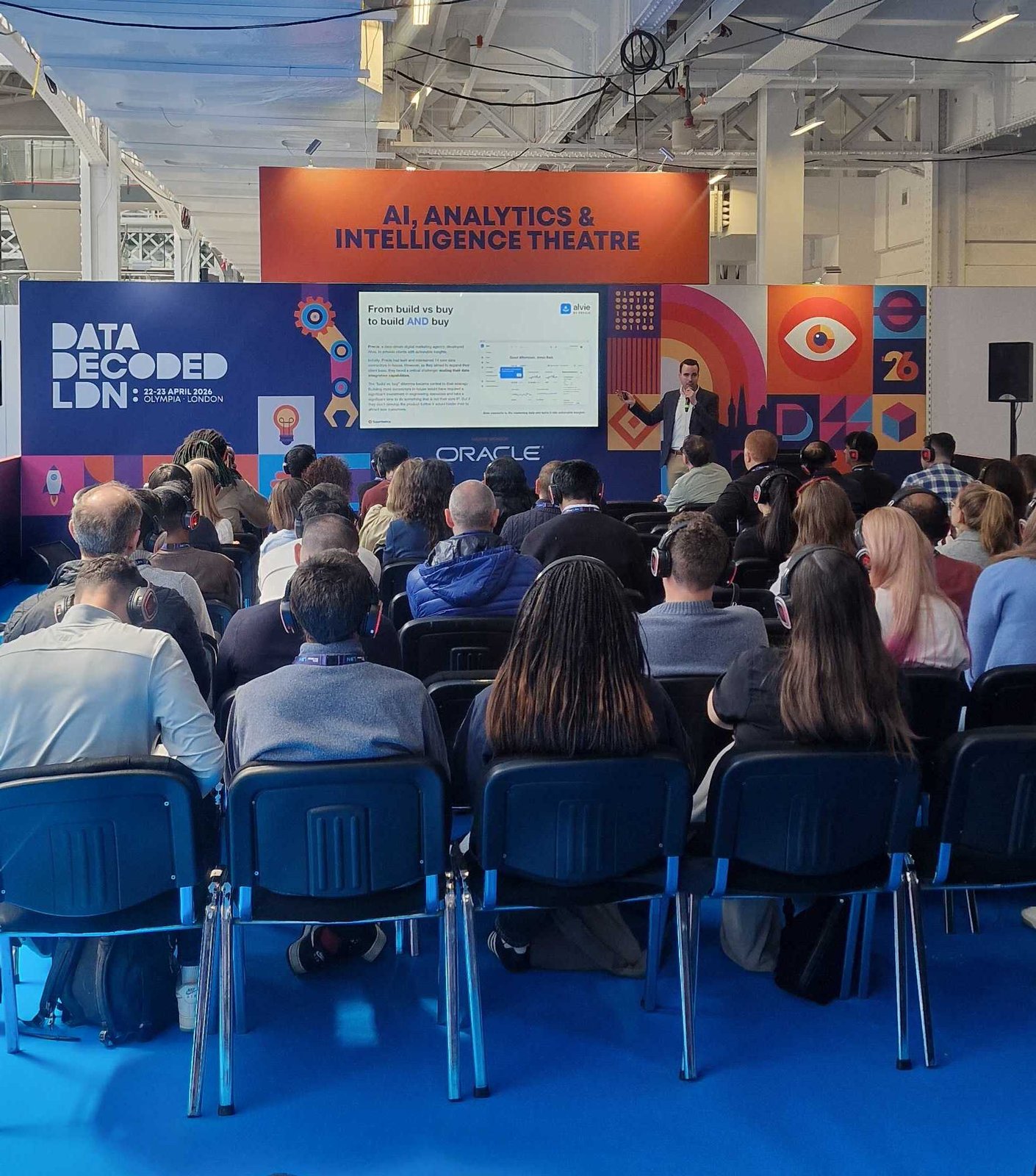 Presenting “AI is Disrupting BI: Why Marketing is the Canary in the Coalmine” at the AI, Analytics & Intelligence Theatre at Olympia London.
Two structural patterns stood out on the floor:
- The Rise of BYOK (“Bring Your Own Key”): Gone are the days when software vendors can force customers into a throttled, proprietary chatbot. The new enterprise default is routing normalized organizational context directly into frontier models (Claude, Gemini, GPT) via BYOK architectures. Data teams must prepare high-context data feeds for these systems rather than just building dashboards on top of them.
- The Compliance Divergence: In regulated industries, security governance is a heavy brake. You could immediately spot the difference between companies six months into their AI transition and those stuck in compliance review while competitors deploy agents into production.
The 84-Point Chasm: Why 95% of GenAI Pilots Stall
The statistic in my presentation that drew the sharpest reaction illustrates the gap between boardroom mandate and engineering reality: 90% of organizations report executive pressure to adopt AI, yet only 6% have fully integrated AI into production workflows.
That is an 84 percentage-point chasm between expectation and reality. Confirming this disconnect, the MIT NANDA study found that 95% of corporate GenAI projects fail to deliver measurable P&L impact. That is not innovation; it is expensive experimentation.
What is stopping the other 84%? The failure modes divide across two axes: technology challenges (which are nontrivial, but solvable) and human organizational dynamics (which are substantially harder).
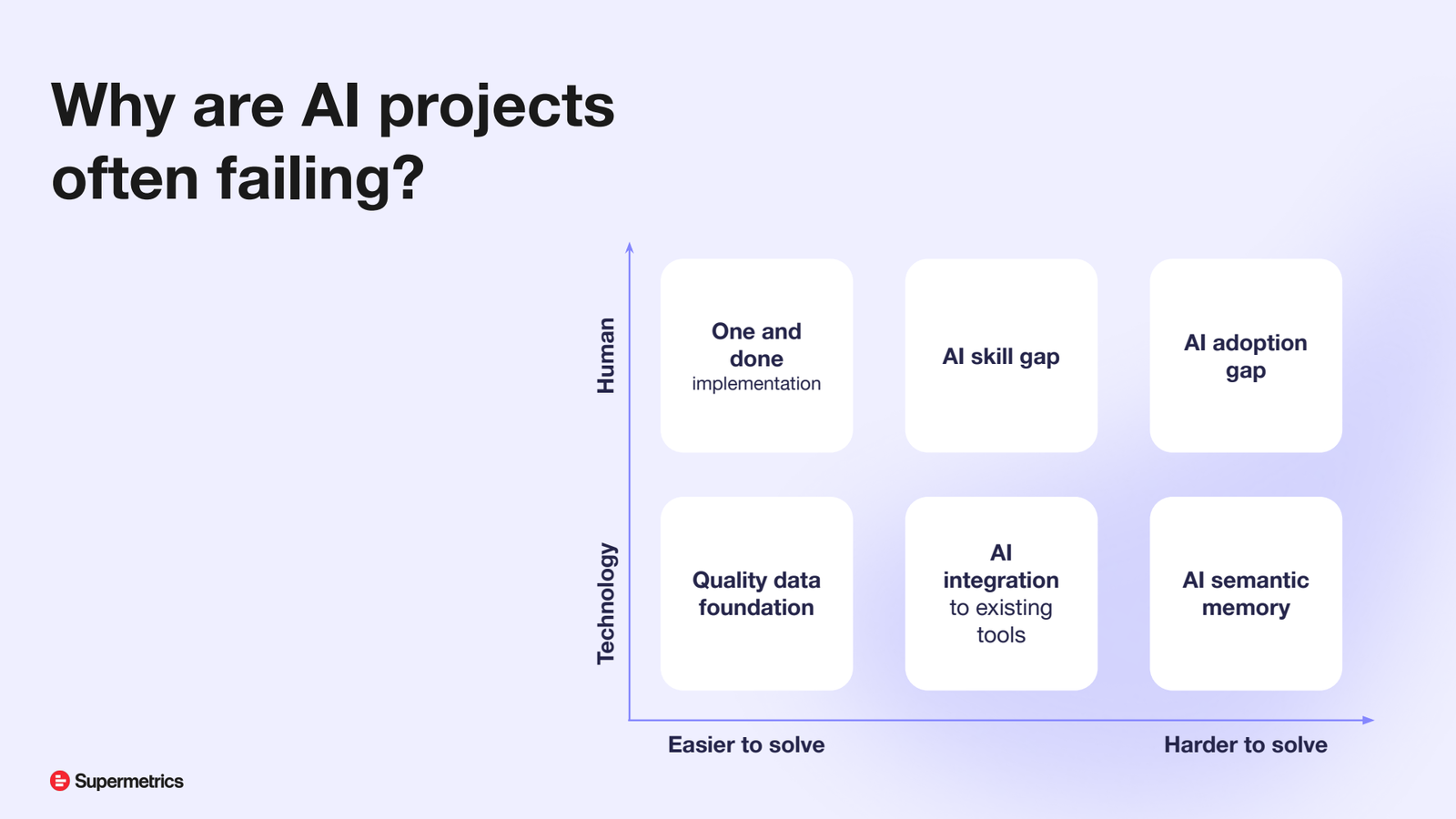 Why AI initiatives stall: technology hurdles (data foundations, tool integrations, and semantic memory) are ultimately easier to engineer around than human barriers (skill gaps, adoption resistance, and one-and-done implementation mindsets).
On the technology side, enterprises fall into the Generalist Trap: relying on frontier models that understand language syntax but lack domain-specific business logic. A minor semantic ambiguity, such as interpreting “first week” of a campaign as the first partial ISO week rather than the first seven calendar days, triggers cascading errors. In lean environments, “confidently wrong” outputs rapidly destroy trust.
Second, AI systems require semantic memory and integration context. Models must know what actions were already taken and what state upstream systems hold. Yet in our research, 52% of the time data strategy lives entirely outside the marketing department, and 59% of marketers do not trust their own team’s ability to interpret internal data accurately. Asking an LLM to make autonomous budget decisions across fragmented silos without a shared semantic memory layer is asking it to fly blind.
Even so, the human side of the matrix is the steeper climb. The AI skill gap, institutional resistance, and a “one-and-done” implementation mindset derail more initiatives than bad SQL. Recent Harvard Business Review research shows that over 25% of marketing professionals report acute cognitive exhaustion (“brain fry”) when using AI, and teams overseeing autonomous agent execution are nearly twice as likely to experience burnout as their software engineering or IT peers. The weight of executive expectations and job anxiety is outrunning the training and guardrails provided to frontline teams.
The CFO’s Dilemma: Why You Aren’t Meta or Google
A recurring question in our booth discussions centered on the CFO’s dilemma: Do we use AI to cut costs, or do we use it to boost revenue?
For most enterprises, the highest-value initiative does not involve building internal foundation models or custom recommendation engines. Simply put: you are not Meta, and you are not Google.
Alphabet and Meta operate multi-trillion-dollar algorithmic customer acquisition machines whose sole purpose is matching consumer intent with commercial offers. If you rely on paid media for customer acquisition, trying to out-engineer their bidding algorithms internally is a poor allocation of capital. Your highest ROI comes from Data Activation: collecting, organizing, and piping rich first-party customer data back into those external engines faster than your competitors.
In practice, Data Activation combines two layers:
- Connect: Ingesting first-party CRM records, data warehouse tables, marketing automation touchpoints, and online/offline POS transactions into unified customer profiles.
- Activate: Orchestrating cross-channel customer journeys, real-time bid adjustments based on purchase propensity, and automated audience retargeting or exclusion.
According to our research, only 24% of organizations have achieved personalization at scale today, leaving three-quarters of the market behind. However, 38% of respondents plan to invest in personalization at scale in 2026, unlocked by agentic development and automated pipelines. As several private equity partners noted at the event, activating years of dormant first-party data across portfolio companies to cement competitive moats is one of the most overlooked value-creation levers in the market.
Velocity vs. Volume: Why Speed-to-Insight is the Metric That Matters
Data engineering teams have historically evaluated themselves on Volume (completeness, historical depth, and accuracy). In an environment where campaign and pricing decisions happen in real time, Velocity (speed-to-insight) matters more.
Our benchmark research reveals that 50% of the time, it takes frontline marketers one to three days to get answers to basic questions from their data teams. Making Tuesday’s budget optimization decisions using last week’s data is a structural competitive disadvantage.
Data teams should measure how quickly stakeholders can access actionable information: tracking median time-to-answer for ad-hoc requests, running quarterly internal NPS surveys with commercial teams, and tying data velocity KPIs directly to customer acquisition outcomes. When data leaders worry that prioritizing speed sacrifices data governance, the answer is splitting the architecture into two complementary paths:
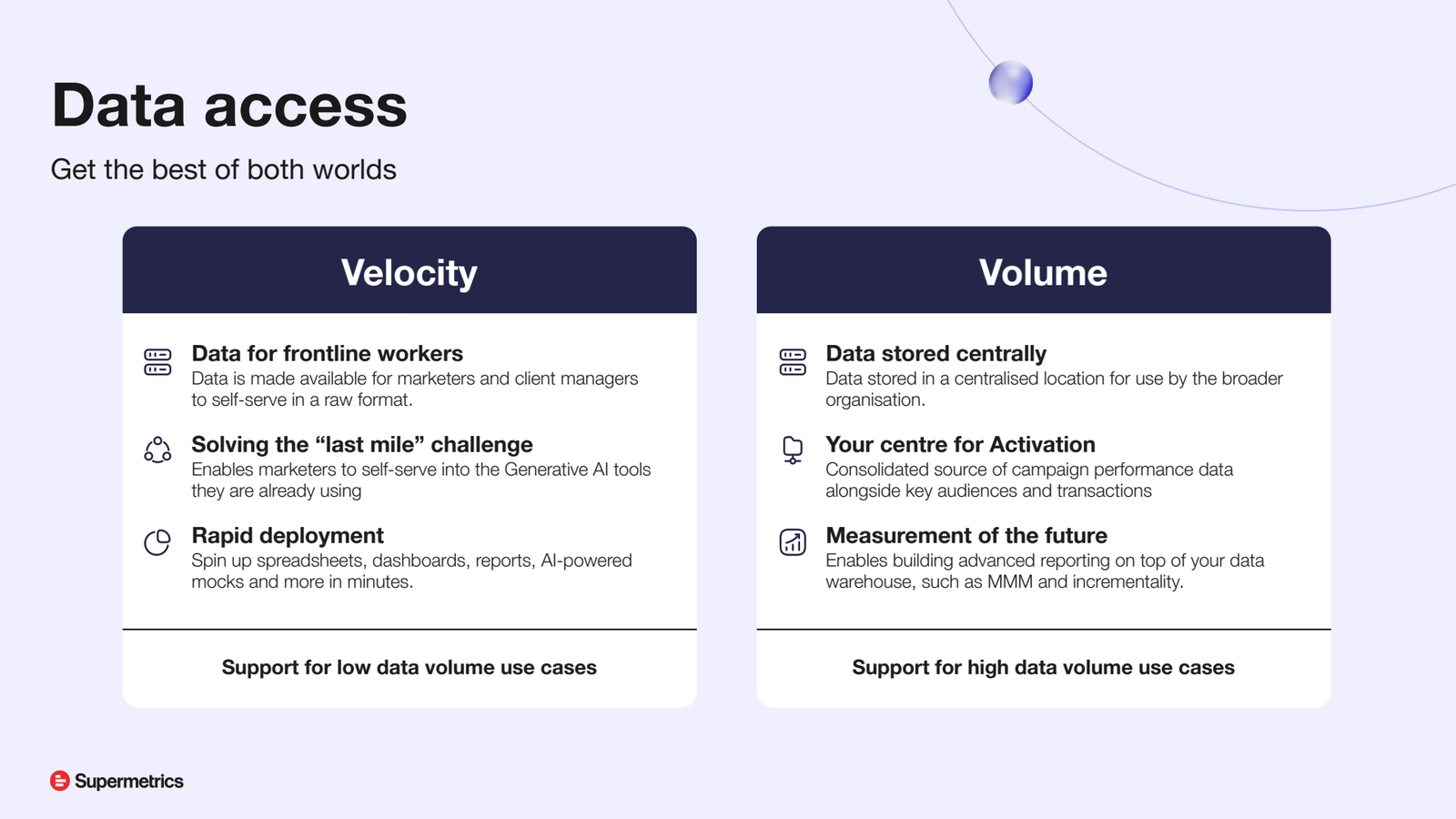 Two-speed data architecture: pairing an on-demand Velocity lane for rapid frontline experimentation with a governed Volume lane in the central warehouse for econometric modeling.
- On-Demand Data (Velocity): Frontline workers self-serve normalized data directly into spreadsheets, BI tools, and AI workspaces. This solves the “last mile” bottleneck and lets teams spin up campaign pacing reports, creative tracking, and AI-assisted analysis in minutes.
- Centralized Data (Volume): Governed datasets stored in the central cloud warehouse (Snowflake, BigQuery, Databricks) for advanced reporting, Marketing Mix Modeling (MMM), incrementality testing, and demand forecasting.
Data teams must evolve from building dashboards to building data products. Frontline operators should never wait three days in a ticket queue for business-as-usual questions, and senior data engineers should not spend their weeks fielding ad-hoc CSV requests instead of building strategic econometric models.
Build AND Buy: Where the Real Moat Lives
The classic “build vs. buy” debate surfaced in nearly every deep architectural conversation at Olympia. One representative from one of the largest consumer advertisers on the planet spent ten minutes at our booth, twenty minutes in a live technical demo, and stayed for the full theater presentation to examine how to consolidate, govern, and enforce taxonomy across a massive global advertising footprint.
The right question is never “Should we build or buy?” It is: “Where do we invest our finite, high-cost engineering talent to build a unique competitive advantage?”
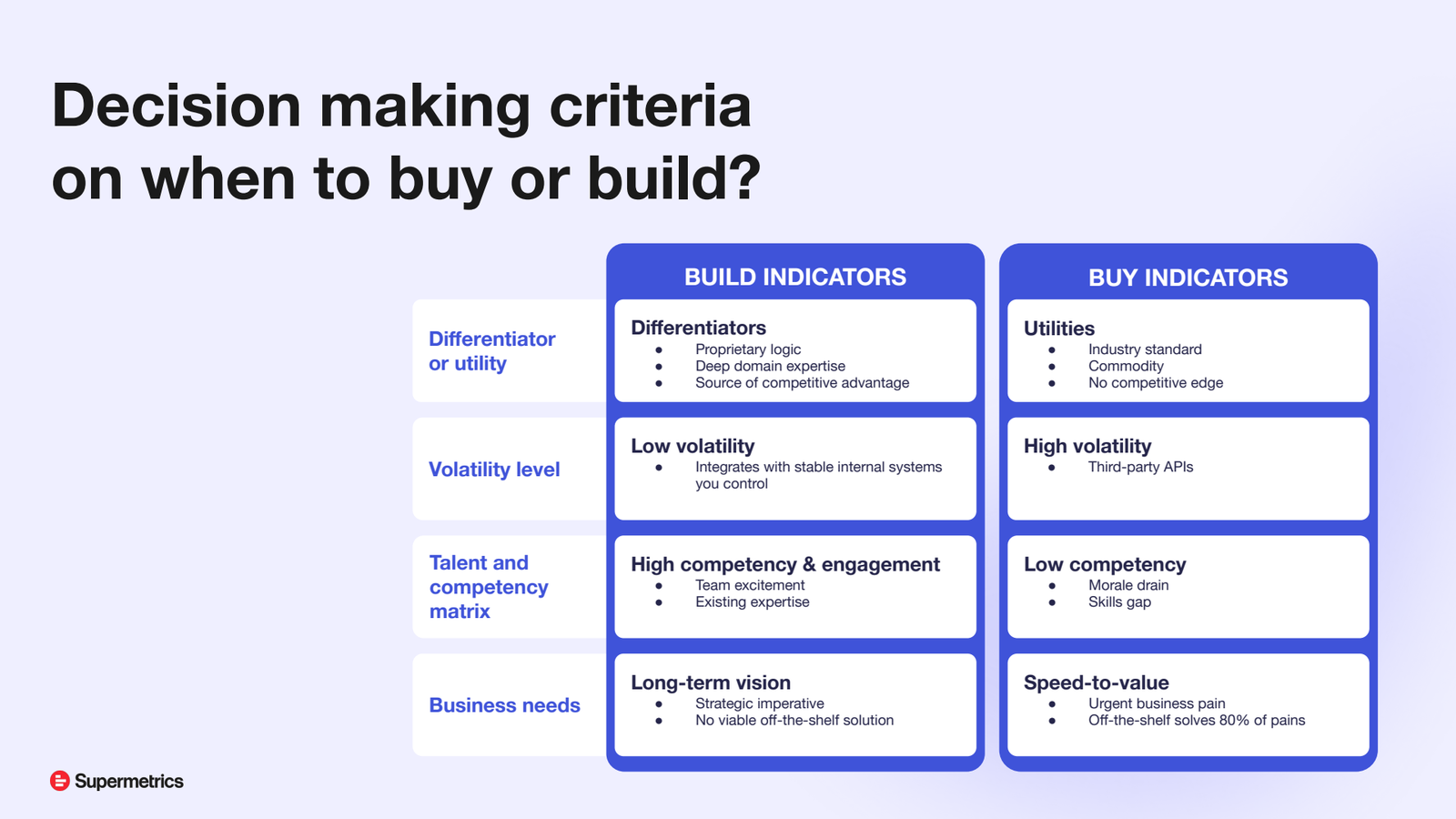 The Build vs. Buy decision matrix: deploy internal engineering talent on low-volatility proprietary differentiators, and outsource high-volatility commodity integrations.
We evaluate this across four criteria:
- Differentiator or Utility: Is this capability core IP and proprietary logic, or a complex but necessary commodity?
- Volatility Level: Internal systems you control change rarely; third-party marketing APIs change constantly.
- Talent and Competency: Do you have the in-house excitement to maintain this, or will API maintenance drain engineering morale?
- Business Needs: Does an off-the-shelf platform solve 80% of the pain immediately? According to the MIT study, AI projects utilizing strategic partnerships (the buy/hybrid approach) are twice as likely to succeed as purely internal builds.
The winning model is Build AND Buy: outsource the volatile, non-core infrastructure, and own the differentiation at the application layer.
The Alvie by Precis Case Study
Consider Alvie, the marketing performance platform built by Precis, a data-driven marketing agency with over 500 specialists. Initially, Precis built and maintained 14 core data connectors in-house. As client demand expanded into long-tail channels, connector maintenance became a severe engineering bottleneck that starved core product development.
By adopting the Supermetrics API for their ingestion layer, Precis achieved immediate operational leverage:
- Expanded from 14 in-house connectors to over 100 marketing data sources in under two months.
- Avoided hiring 5 to 10 full-time engineers dedicated solely to connector maintenance.
- Reduced new platform onboarding from multi-week sprints to 1 to 2 days.
As Jonas Bæk, Head of Product at Alvie, put it: “The ROI of implementing a new marketing platform from scratch that only one or two clients will use isn’t great. With Supermetrics we were able to bypass that risk and gain access to a large number of long-tail data sources.”
If your core business is data aggregation (i.e., our direct competitors), you should obviously build and maintain your own connectors. For everyone else, even digitally native leaders like Uber or Airbnb, innovating at the data pipeline layer is a misallocation of talent. As Alvie proved by focusing its engineers on attribution modeling, budget optimization, and bidding strategy on top of Supermetrics, the moat lives at the application layer, not in the plumbing.
Solving for WRITE and Composable Martech OS
We brought two theater presentations and a live engineering lab to London to demonstrate where this architecture goes next. Alongside my keynote, my colleague Valter Andersson presented “Solving for WRITE: Why Data Engineering Doesn’t End at the Warehouse.” His thesis resonated across the room: the modern data stack has solved the READ side (querying, reporting, and warehouse analytics). The next frontier is WRITE: empowering data systems to act across external platforms with persistent memory, timing, and coordination.
At the booth, Pieter Van Groenendael demonstrated a bespoke “Martech OS” built on Build On, our composable API product, showing how engineering teams can rapidly assemble custom AI applications atop a governed data foundation.
 Hands-on architecture at the booth: Pieter Van Groenendael running live demonstrations of a composable Martech OS built on the Supermetrics API foundation.
We also hosted a five-person delegation from The Economist (an existing Supermetrics customer) at the booth. Engaging with data practitioners who sit outside everyday marketing execution underscored the broader shift we witnessed all week in London: enterprise data teams are no longer treating marketing as someone else’s problem.
The Six-Month Horizon
With Data Decoded expanding from Manchester to London and eyeing a United States launch, the signal from the infrastructure floor is unmistakable. Nobody has enterprise AI completely figured out yet, and 95% of isolated pilots still stall before reaching the P&L.
However, the organizations pulling ahead are not waiting in compliance committees or burning senior engineering hours maintaining commodity API connectors. They are watching marketing closely because liquid capital and instant feedback loops make it the enterprise proving ground. The architectural patterns being forged in marketing today (BYOK frontier model pipelines, two-speed velocity architectures, hybrid build-and-buy ingestion, and programmatic write-back) will become mandatory across finance, supply chain, and operations within six months. Data teams that master this blueprint now will be ready when the rest of the enterprise arrives.